


Hopefully, by now, everyone understands how important search is on a website. For many users, it is the last resort when they can’t find what they need in the main navigation. (And, in my experience, library navigation labels are often not especially helpful.)
For other users, search is the starting point. They skip the navigation entirely and expect the search feature to act as an answer engine.
Either way, a website’s search function is a mission-critical feature. But simply having a search box on your library’s website is not enough. There is a lot of research about what makes site search effective, and in this post I want to focus on one issue I see libraries overlook all the time: search placeholder text.
If you’re not sure what I’m referring to, take a look at this image:
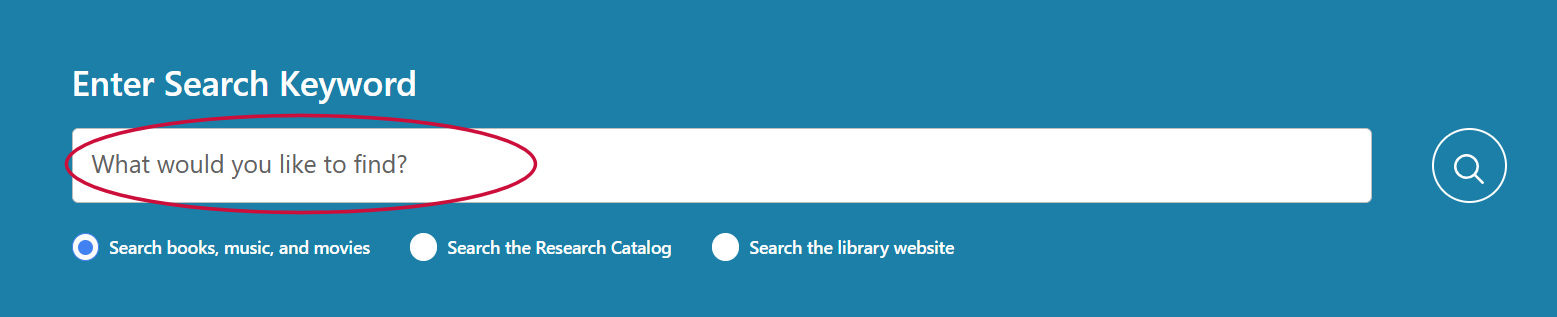
The text in the red oval is called “placeholder text.” It’s any text that appears in a search field before the user has typed anything. For years, I included this in my own designs. I assumed, probably like most others, that this text was helpful to users. Turns out, it’s definitely not.
In 2014, The Nielsen Norman Group studied how users interacted with placeholder text. Across the board, it found that placeholder text caused more harm than good, with at least seven (7) negative consequences for users, both with and without disabilities. In addition, for users with disabilities, three more problems are often present:
The color contrast of placeholder text against the field background is often not strong enough to meet WCAG requirements;
Many problems in the original seven are magnified for people with cognitive or motor disabilities, and
Some screen readers don’t read placeholder text at all.
With all of these problems, why would any library keep using placeholder text?
As far as I can tell, there are only two reasons:
They don’t know better.
They don’t care.
That’s it.
If you are reading this, the first reason is no longer an excuse. The second is up to you.